Tag: pattern-generation

  • Octave Pedal Tone patterns and the CAGED System

    As you navigate the octave pedal tone exercises you might start to notice that the octave shapes have a fair amount of predictability, even while the internal sequence of notes differs, sometimes greatly, from one to the next. Becoming familiar with these octave shapes can be very helpful in your playing and understanding of the fingerboard, and can also shine a light on one of the more useful aspects of the CAGED system: the consistency of the octave shapes found within our five open position Major chords.

    The most common octave shape is the one found between the outer notes of the 3-string power chords whose bass notes are on the 5th and 6th strings. That’s the octave shape that Wes Montgomery and others most often use to play octave melodies (though for jazzers the D shape octave and upper octave of the G shape also figure in plentifully.)
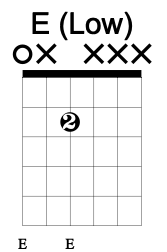
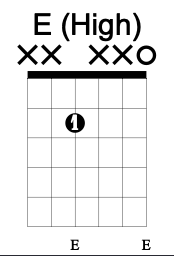
    This is the lower octave of the E Major Octave shape
    This is the octave shape from the A Chord

    The E chord shape actually has two distinct octave shapes within it: the low one is the box-shape commonly associated with the aforementioned power chords, i.e. “two frets up and two strings higher” while the shape of the E chord’s upper octave is a little more shy about presenting itself. It is the larger upside down L shape that is found between the 2nd fret of the 4th string and the open 1st string. If we move it up one fret we see that it outlines the ‘beginner’ 4-string F chord and, moving onward up the neck, has a shape that can be described as “2 frets down and 3 strings up”. That inverted ‘L’ shape can also be found in the C chord where the octave is found between the 3rd fret of the 5th string and the 1st fret of the 2nd string. It’s the identical “2 frets down and 3 strings up” shape of the upper octave in the E shape.

    There are 3 E’s and 2 octave shapes
    in the open E Chord
    Here we see the upper octave of the E shape; 2 frets down and 3 strings higher.
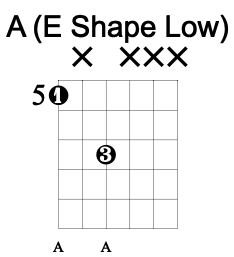
    The low octave of the E shape placed at the 5th fret
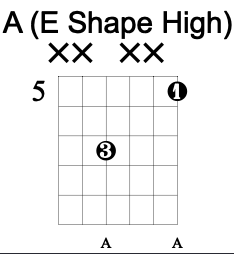
    The High octave of the E shape at the 5th fret

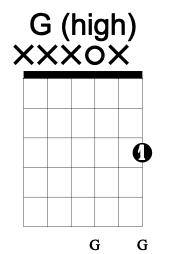
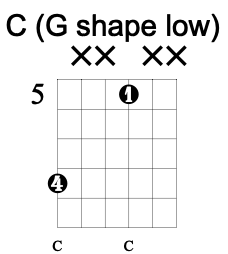
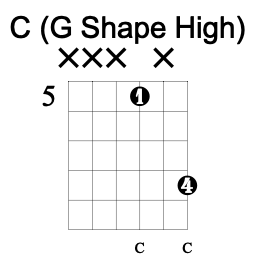
    moving to the G shape we have another open chord that contains two octave shapes. This chord’s lower octave is found between the 3rd fret of the 6th string and the open 3rd string. We could say, “3 frets down and 3 strings up”. So, for example, if we looked for the C octave using the lower octave shape of the G chord we would first want to locate the C note at the 8th fret of the low E string and then connect this with the 5th fret of the 3rd string; that follows the 3 frets down and 3 strings up pattern. This shape is a very important one for the octave pedal tone exercise and is a great one to be familiar with because of the amount of space between the octave for melodies and harmonies to be explored!
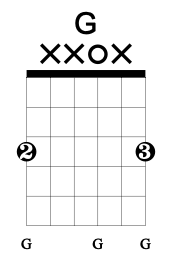
    G chord and it’s 3(!) octave shapes! I would be very remiss to not mention the outer notes and the double octave they make up.
    Low Octave of the G Shape
    High octave of the G shape
    Low Octave of the G shape at the 8th fret. This is a C Octave in the G shape.
    High Octave of the G shape at the 5th fret. This is a C octave in the upper register of the G Shape

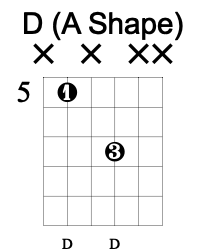
    The octave shape found within the A chord shape is identical to the lower octave of the E chord. It is the ‘box’ shape that I earlier described as two frets up and two strings higher.
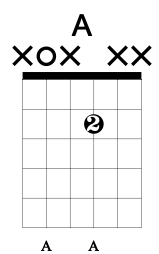
    Open A Octave shape
    A Octave Shape at the 5th fret. This is a D octave in the A shape

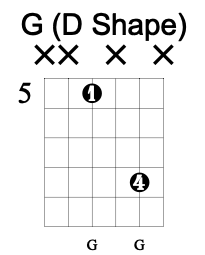
    The D chord’s octave shape is found between the open 4th string and the 3rd fret of the 2nd string and as such is identical to the upper octave of the G chord shape.
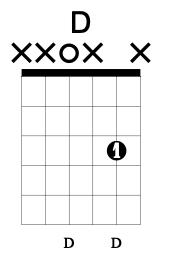
    This is the D Octave shape
    This is the D Octave shape at the 5th fret, which makes this a G Octave

    My personal favourite of all the open chord octave shapes is the C chord! It fits beautifully in the hand and offers loads of melodic and harmonic opportunity in between the low and high notes. The M7 is within easy reach with the 4th finger, the b3 to 3 ornament is a simple 1st to 2nd finger hammer on. There are many beautiful colours readily available and with practice you will see them all, no pun intended: )
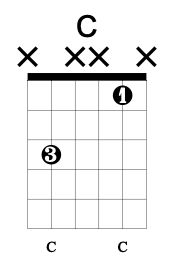
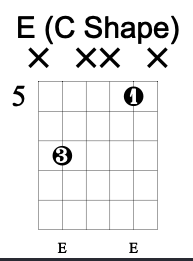
    This is the C Chord’s Octave shape; 2 frets down and 3 strings up
    This is the C Chord octave shape at the 7th fret of the A string; making the sound of an E octave

    So, looking at the 5 chords of the CAGED system, we find 7 octave shapes: 5 chords plus 2 extras in the G and E shapes. Of those 7 shapes only 4 of them are unique/non-redundant. E and A share a shape; C and E share a shape; D and G share a shape and the one shape that doesn’t share itself with other chords is the lower octave shape of the G chord.

    Here is a pdf of all the above shapes in one handy place.

    Though I may be belabouring the point a little, the important thing to know is that getting really comfortable with your octave shapes is a great way to bolster your conception and understanding of the harmonic and melodic layout of your fingerboard.

    Thanks for visiting and Happy Practicing!

  • A Step Away from Home: Octave Pedal Tone Exercise in D Dorian

    As we build our awareness of the fingerboard on our way to becoming fluent and fluid with the Pattern Generation approach to creative practicing, we must develop our mastery over the major scale. This journey means that we are going to be playing the Octave Pedal Tone exercises from and to notes in the scale other than the Tonic. These can be thought of by their Modal signifiers or they can just be thought of as the Major scale from the 2nd scale degree to the 2nd scale degree an octave higher or lower.

    Or the 3rd or the 4th or the 5th etc, etc.

    The reason that I’m using the Modal label for these is that (because of the fact that we are pedalling back to the root every other note) we are actually really hearing the mode and it’s colours and tensions, consonance and dissonance in a meaningful way. Every time we hit the root and then go to the next scale degree we are hearing the colour of those notes relative to that pedal tone. There are actually a few different layers of thought that we can be exploring when navigating through the modes in this way.

    One layer of thought or perception that we might explore as we move through the exercise is that we have started on the 2nd scale degree and so the W/H pattern will orient itself around that starting point. That is to clumsily say that the 3 of the major scale will be the second note and the 4 will be the third etc. You might narrate the exercise in just that way, i.e. “2 goes a whole step to 3 goes a half step to 4 goes a whole step to 5 goes a whole step to 6 goes a whole step to 7 goes a half step to 8 goes a whole step to 2/9”. There’s a fluidity to that passage that can fit nicely within the 8th note rhythm of a basic pedal tone exercise; you should try it: )

    Another perspective you can have is that you are playing a Dorian mode, which is a minor scale with a Major 6th; a Major scale with a flattened 3rd and 7th; or a minor scale that has the scale template: W-H-W-W-W-H-W.

    You could also just stay within the musical alphabet and remember that E & F and B & C are always a half step apart while every other adjacent pair is always a whole step.

    Whatever perspective you take, what we’re really trying to do here is develop a sense of control, awareness, and fluidity over the scale so that we can reduce limitations and elevate our ability to create and move through the infinite variety of patterns available to us as we write or improvise or work on new melodic/harmonic vocabulary.

    This video is played at 80 bpm but you can and should feel open to slowing it down or speeding it up. You can and should add rhythm. You can use a pedal like the EHX Freeze to lay down a chord and hear the harmonic context of all this goodness.

    Speaking of playing a pad or chord in the background while playing this exercise, that is exactly the reason why I am not a huge fan of the fact that I have called this exercise a Dorian exercise. It is absolutely the case that if we play this pattern by itself or while sounding a Dmin chord we will hear the character and qualities of the Dorian mode. However, if you play this over a G7 chord/groove you will hear the sound of Mixolydian. If you play it over FMaj7 you will hear it as a Lydian sound. Why is that? Because it’s the chord that defines the modal character/perspective, not the scale!

    Mostly.

    If you are playing over a drone, let’s say D, and you use the notes of the C Major scale, you will hear the characteristics of Dorian but, if you then shift your note choices to the key of A, you will have manifested the D Lydian mode. Modal music does allow for these creative impositions of modal shifting, but for the vast majority of Classical, pop, blues, jazz, traditional music etc what we are generally experiencing is music that is based around harmonic and melodic interactions, i.e. chord progressions and melodies. If a song has chords that change every couple of beats or bars, it is then, by definition, not Modal music. This is why I struggle to direct a student’s focus towards modal delineations. For certain taxonomically valid reasons however, modal labels have to be acknowledged as useful: )

    Thanks for visiting/downloading/listening and happy practicing! to you!