The real beginning point for any and all of what’s to come is to develop your ability to play up and down the length of every string in any and every key. Without thinking too hard about it!
It should not be a challenge to play the G Major scale up and down the B string, or the Ab Major scale up and down the G string.
The formula is twofold: the first most important thing to remember is the Major Scale Template, which is that the spacing between the notes from tonic to tonic is W W H W W W H (where W represents a Whole step and H represents the Half step.) In order to internalize this easily just think of the piano keyboard…if you can’t think of it use this device your looking at this artical on and find a photo: ) What you will notice if you look even remotely closely is that there is a pattern/sequence of black keys that alternate in groups of 2 and 3. Just like our W/H pattern in the Major Scale Template. THe group of two black keys represents the group of two Whole Steps and the group of three black keys represents the group of three Whole Steps. The gaps in between the black keys where we find two white keys side by side are the naturally occurring Half Steps in the Major Scale. the two white keys following the group of 2 black keys are the half step between E and F, or 3 and 4, while the two white keys following the group of 3 black keys is the Half Step between B and C, or 7 and 8. Take a minute, there’s not rush and there’s no pressure. Just remember W-W-H-W-W-W-H; Two black keys and a space then Three black keys and a space.
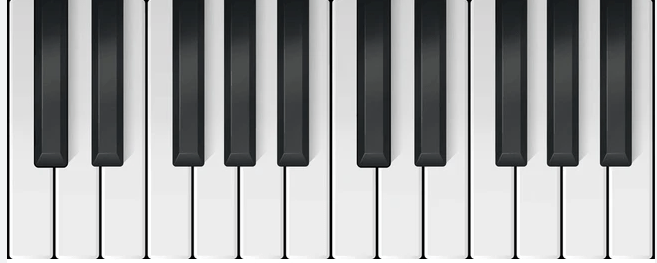
From this we derive the second part of the formula: the Half Steps are found in between the 3rd & 4th and 7th & 8th notes of the scale. This is important because if you know where your starting note is located in the diatonic scale number system, you can guide yourself along the string by counting steps and moving in Whole steps unless you are moving up or down between the 3rd & 4th or 7th & 8th degrees (notes). It’s not that tricky once you get your hands into it!
Check out the following images:

The only times in the above example where we move in a one fret increment are between the 3rd and 4th or the 7th and 8th notes of the scale. We start on E because it’s the lowest note on the string. E is the 3rd note in the C Major scale (C-D-E) and so the next note is the 4th and we see that it is up only one fret, or one Half Step. Following steps 4, 5, and 6, which are unsurprisingly all Whole Steps, we get to the next Half Step which is between B and C or notes 7 and 8 in the scale. Then we move through scale degrees 1, 2 and 3, whereupon we arrive again at a half step between scale degrees 3 and 4 only this time one octave higher than the first two notes on the string and we decide somewhat arbitrarily to top out at the 15th fret with a High G. THen we descend along the string playing all the same notes only in reverse. That’s basically how this will work for all 6 strings.
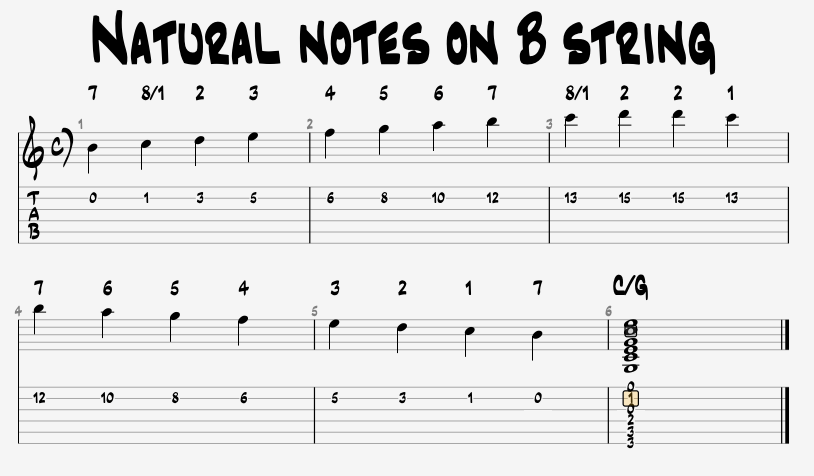
Summarily, B is the open string and that is the 7th of the C Major scale so the very next note is 8/1 and that is why we moved by one Half Step. We see the next Half Step at the 5th and 6th frets, between the notes E and F which also happen to be the 3rd and 4th notes in C respectively. We proceed up the string to the High D and then back down. We will be ending each example with a big C/G chaser just to give harmonic context and resolution to the preceding scale passage.
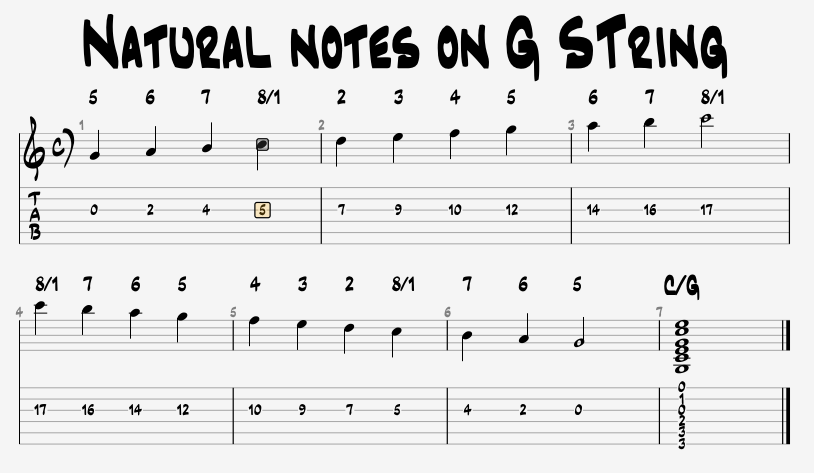
This is the first time that the first two notes on the string are two frets apart, or one Whole Step. Why is that? Because the first note is G, or the 5th of the C Major scale and the distance between the 5th and 6th scale degrees is a Whole Step or 2 frets. Proceed slowly and musically and track your notes always. The tab is presented here merely as a reference. These maps need to be generated in your hands and eyes and brain. Trust me that your ear WILL lead you astray! That’s because none of these examples starts on the tonic. That means you will not get the ‘Do Re Mi’ that your ear is so desperately searching and hoping for! Engage the narrative! Use the numbers! Play half steps only between the 3rd and 4th notes and the 7th and 8th notes of the scale. Always be aware of where you started and where you are going.
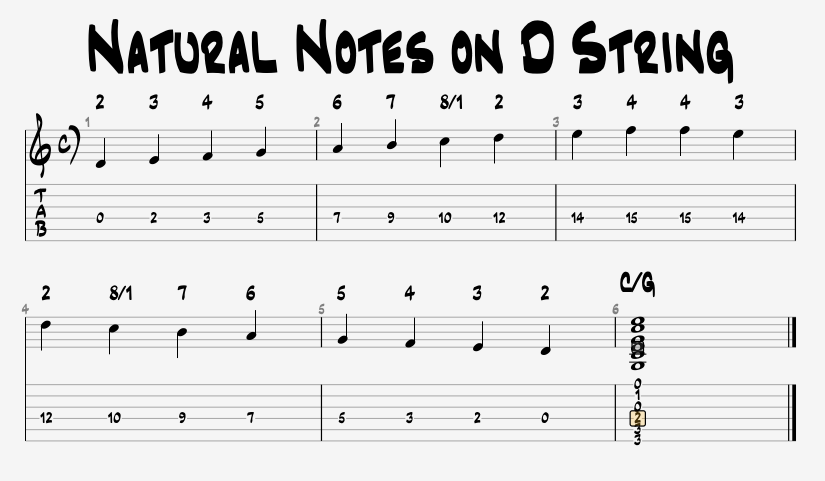
I’m saying a lot, I’m going to let you see/play/think your way through this one.

And this one…
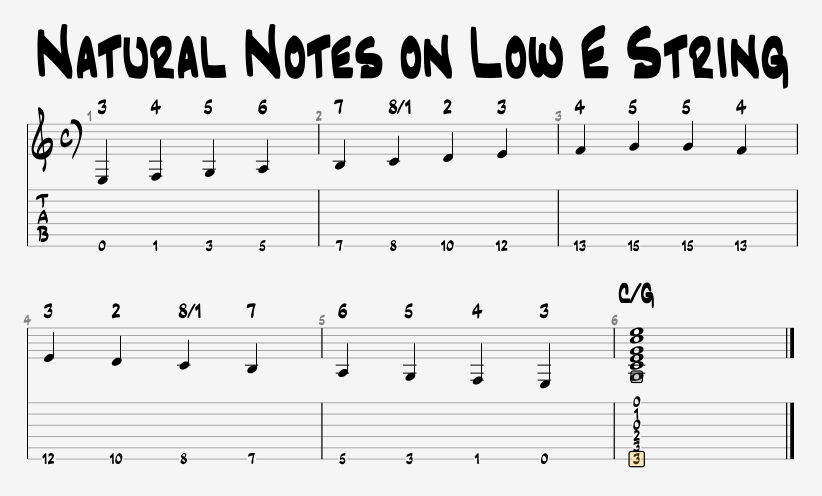
The Low E String is identical to the High E String except that it is two octaves lower in pitch. I always like to use these two strings to feel, in a musical way, the old passage “As above, so below”. An interesting bit of physics is that the reason for this two octave difference between the two Es is that the low E string is vibrating at exactly 1/4 the rate of the High E String, exactly! The E that is one octave lower than the High E string is vibrating at exactly 1/2 the frequency rate of that Hi E note, which as we might notice is available to us in a number of places along the neck. Can you find them all?
IMHO this doesn’t so much need a video but I will work on one nonetheless, so check back for a link to that in a day or two. Until then, as usual, happy practicing!
 Pattern Generation