It’s kind of interesting that for a scale that has so much in common with the restful and homebody-esque major scale, the Mixolydian Mode couldn’t really be any more energetically different.
Major/Ionian = home/grounded
Mixolydian = uprooted/restless
It is hard to argue that the ungrounded and restless nature of the mixolydian mode and its harmonic partner, the Dominant 7th chord, are what made it the definitive melodic and harmonic material for the blues. The Blues, after all, was essentially the music of a culture of people who were taken from their homes, held captive, made to work as slaves, and we’re essentially powerless to return home. They were stuck in an existential embodiment of the mixolydian mode.
I hope that doesn’t sound trite because it really isn’t.
That deeply embedded bluesy quality of the Mixolydian Mode is what made it important to realize this Octave Pedal Tone exercise with a shuffle feel. Technically this requires a right hand/arm physicality that is similar to what the great Stevie Ray Vaughn does to achieve the rhythmic feel of songs like Pride & Joy and Rude Mood.
Downstroke on the beat and upstroke on the triplet 8th that defines the shuffle, sometimes from the hand/wrist and sometimes from the forearm. Make sure to always stay as loose as possible and put rhythm and groove over string and note accuracy. Let the accuracy come as the physical develops, the physical development will never lead you to groove if it’s coming from a place of cautious accuracy.
There are a couple of occasions in this mixo manifestation where the moving voice extends into the double octave. I feel these moments sound especially bluesy. But then so do the moments when the ascending voice moves in toward the unison and we hear the flat 7th (F) rub idiosyncratically against the root (G). I guess it’s silly to say that any of the registers sound more or less bluesy than others because it’s all pretty danged bluesy.
Thanks for caring enough to stop by and grab the tab. Stay tuned for the next step of the scale, the Aeolian mode (or relative minor). Keep in mind that these modal focused OPTs are really just the foundation of all the exploratory pattern generational fun that lies ahead.
Ordinarily I try to stay away from clickbait videos on youtube. Unless it has to do with cooking or tying knots or some other skill I am working on developing, I try to avoid it all. But once in a while I click on guitar/theory/music related ones just to see what people are on about; once in a while there are real gems, but usually it’s super annoying!
On this fine early spring Saturday morning I saw Matteo Mancuso’s smiling face and, knowing how brilliant he is, I clicked. The title of course was full on clickbait and the comments section was a den of keyboard music theory warriors crying foul of his use of non major scale note choices. I felt this was a bit over the top and his solo sounded pretty diatonic to my ears as he weaved around the non-diatonic chords in the progression. Obviously there were a couple of nods to the changes but I chose to transcribe the solo to see to what extent my ears might have been deceiving me. I was stoked to find that my original impression was the accurate one.
There is no question that Matteo Mancuso is one of the young shining lights of guitar music, his chops, his improvisational skills, his tone, his demeanour, he is everything that a successful young professional musician needs to have; take note if you are aspiring to make music your career: be a good person who plays exceedingly well and you have a shot at paying your bills with your instrument for your whole lifetime!
The thing that invariably makes me shake my head a little is the comments section. Uuuugh!! Now, this video (to which I will link below) is supposed to be an example of Matteo playing on a soulful little loop using only the C Major scale. The progression is as follows: ll:CMaj7 / / / l E7 / / / lFMaj7 / / / lG7 / / / :ll On the 3rd repeat the G7 is replaced by an Fmin7 (a tasty little iv-7 is never a bad choice, unless it happens everytime!).
Obviously this is a highly skilled and tasty piece of guitar mastery! The frustrating thing is twofold. First of all it’s the clickbait title: no one can just “unlock” the major scale and play like this. The scale is not the only part of what is happening here! The chord changes are the prism through which the light of the notes refract and create different colours. The chord progression is also 1/4 non-diatonic, i.e. the E7 chord presents some navigational issues that might force a novice guitarist/improvisor to question their life choices when they keep landing on the G natural and being made to wonder why it sounds the way it does. The Fmin7 in the 3rd repeat is non-diatonic as well, forcing the player to navigate a chord that has just shifted two of the major scale’s notes to the flat side (Ab, Bb and Eb in this case). So we’re doing a lot more than “unlocking” the Major Scale! Come on Paul!
The second frustrating aspect of falling for clickbait titles is the Comments section! Now just like I’m doing here we have almost nothing but people crying foul on the title as well. Most everyone is choosing to point out that there is more going on than just the Major scale. Lots of observations of b13s, which is not exactly correct in a sense because while an Ab is inded the b6th of the key of C, it happens to be sounding during the E7 chord. This makes it enharmonically a G#, which would make it more accurately a #5 but even more accurately it has, in that moment, nothing at all to do with being a #5 in C because what it really is is a beautifully rendered M3rd on the E7 chord which he arrives at by enclosing within a little E, G, A, melodic sequence which is at once diatonic, and also sweetly pentatonic. Speaking of Pentatonic. One commenter suggested it wasn’t all the Major scale, it had pentatonics as well. We would all do well to appreciate that the pentatonic scale is a frame of the Major scale in the same way that 2x4s are the frame of the house but there is a lot more going on in the finished house than just the studs. Any pentatonic scale is contained within 3 different major scales and so it is not “not the majorscale” just because Matteo chose to use a note sequence that fit within our conventional sense of what a pentatonic scale position “feeeeels” like.
There are two very fleeting moments in bar 8 and near the end in bar 14 where Matteo spices up the solo with a b3 blue note on the C chord. In bar 14 he does this sweet bend from the 10th fret D to the 12th fret E but upon the release of the bend he does a quick little half step bend up to the Eb/b3 (11th fret)then back to the D. He then completes the phrase by pulling-off to the C and returning to the D. This is a very expressive technique and is very difficult to pull off so you should spend some time trying to get it. The early example is a quick upper neighbour slide that is truly felt more than it is heard. But calling these little embellishments non-diatonic is as overblown as claiming that Indian raga is microtonal. It really isn’t that microtonal. Indian Raga is predominantly diatonic/modal with chromatic embellishments that stand out to our ears because they are not the embellishments that most of us are accustomed to hearing.
Anyhoo. In bar 12 Matteo comes across the Fmin7 chord and chooses to express himself on this chord by playing a speedy descending phrase in what is essentially F Dorian but he passes chromatically through the E natural, hearkening to the Be-Bop dominant scale but is otherwise just playing diatonically the most inside note choices possible for the F minor sonority. Yes it’s outside of the C Major scale but ny the tone of the comments section you’d think he just quoted a Schoenberg 12-tone row!
In closing remember, Click Bait sucks and don’t read the comments section when anything related to music theory is being tossed around because it will be 98% overblown and wrong and you will lose brain cells in the process of trying to keep up with the rage bait of the average person’s posts: )
So here is my transcription of Matteo’s great romp through Paul David’s backing track. Have a look at the notation and you will see very few instances of accidentals. In my summation he did a stellar job of keeping his ideas within the boundaries of Mr. Davids’ prompt!
Experiencing harmonic relationships and functions through analogies to travel away from, and returning to, a home base can be very helpful for our understanding and our ear training. Associating chords and progressions in a key in this way can help us understand why some songs and chord sequences can be so evocative of the emotions they convey and also help to shed some insight on why we like the sounds we like and how to write better songs more easily.
To this end I will share with you how I feel about the diatonic chords and they feelings of push and pull away from our restful tonic home base.
We can always experience our tonic, or I chord, as being at home, at rest. No tension, all release. From there and without belabouring the point, I will just share that I feel the colours and tensions of the other chords in the following ways.
The ii- chord is like going away from home, on a trip of some kind. The Dorian mode sort of brings the calm tension of getting to the airport on time but you’re still always a little nervous until your plane takes off.
The iii-chord embodies all the exoticism of being in a new and relatively foreign land. You are very much traveling away from home at this point.
The IV chord to me is the point on your trip when you are the most away from from home and the most settled into that space. It’s exotic, it’s hopefully, it’s dramatic, it’s positive, it’s never boring.
The V7 chord is the end of your trip, it’s compelling you to return home; you’ve had all the food, you’ve had all the drink, you miss your own bed and your own space! The b7 in the V chord is the urge to just get to the airport in one whole piece without forgetting anything.
The vi- chord is your melancholic reflection on the travel home. You’re glad to have gone away, you’re somewhat maybe sad to leave new friends, and maybe an intimate experience or two, behind and you’re reflecting on the return to work and life and the attendant pressures of being an adult human in the world!
The vii° is unsettled, like a rocky landing in the airplane, or a temporarily misplaced or lost suitcase, or a friend who’s delayed in picking you up at the airport. It’s also very much connected to the V7 chord, being in the same harmonic function category, so it carries all the same tensions and pushes us to just want to return home, albeit in a much more tense and unsettled way.
With all that being said, the Lydian mode is, to me, the melodic and harmonic region of the key that is both the furthest home while being at the same time the most restful.
One way to view the Lydian mode in a stand alone kind of way is as a major scale with a raised 4th degree; it is so much more than that, but it is also that!
The lydian mode, or IV chord of the Major scale gives us my personally most favourite extended chord, the Maj7#11. The Lydian (subdominant) is a diatonic region that, like Dorian, which is also subdominant, contains no ‘bad’ notes. Some schools call these notes “avoid notes” but what they really are are notes within the scale that sit a half step above a chord tone. If we look at the IV chord in C, we can observe that even if we look all the way up the stack of 3rds to the 13th of the chord, at no point do we find a non-chord tone that is a half step above a chord tone. 1-M2, M3-#4, P5-M6, M7-P8 is a half step but it is to the octave, M9-M10, #11-P12 is a half step but it is to a chord tone, and M13 to M14 (not a technically used degree because it is the higher octave of the M7th but I’ve used it, along with the P12th, just for observational clarity.) if we follow the same chord-tone/non chord-tone analysis with the ii- cord we find the same thing, there are no non chord tones going a half step above a chord tone, i.e. neither scale/mode/harmonic area result in any avoid tones.
Beyond that and more to the point of this particular Octave Pedal Tone exercise, I have used a rhythmic pattern that places the pedal tone on the and of beats 1 and 3 throughout. So if the low voice is moving through the scale it will be articulated on the 1, the 2 and the & of 2 of each 4 eighth note grouping. Likewise if the moving voice is the higher of the two, it will be the 1st, 3rd and 4th of the pattern while the portal time will be 2nd only.
The other articulatory aspect of this rhythmic approach/manifestation is that I have indicated slurs, i.e. hammers, pulls, and slides, to move from note to note. This is an evolution in our approach to using creative techniques to enhance what might otherwise be slightly boring or stagnant exercises
As always, thanks for visiting and Happy Practicing!
In this example I have taken up with the E Phrygian one more time. I wanted to present another example of how rhythmic variations can make our practicing both more interesting and more challenging, all while increasing our familiarity with all the colours and tensions present within the scales and modes we are choosing to work with.
I won’t say too much more about the mode itself but in this example I chose to take a few different paths through the octaves, unisons and double octaves available to us.
I also imposed an alternating Low/High triplet rhythm onto the pattern so what we hear is a displaced accent on the high notes and low notes; challenging, interesting, and fun!
There is a hi-hat metronome track and a droning E minor chord running in the background to really accentuate the colours of the Phrygian mode.
As you navigate the octave pedal tone exercises you might start to notice that the octave shapes have a fair amount of predictability, even while the internal sequence of notes differs, sometimes greatly, from one to the next. Becoming familiar with these octave shapes can be very helpful in your playing and understanding of the fingerboard, and can also shine a light on one of the more useful aspects of the CAGED system: the consistency of the octave shapes found within our five open position Major chords.
The most common octave shape is the one found between the outer notes of the 3-string power chords whose bass notes are on the 5th and 6th strings. That’s the octave shape that Wes Montgomery and others most often use to play octave melodies (though for jazzers the D shape octave and upper octave of the G shape also figure in plentifully.)
This is the lower octave of the E Major Octave shapeThis is the octave shape from the A Chord
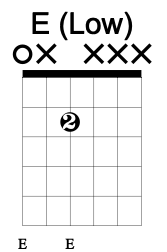
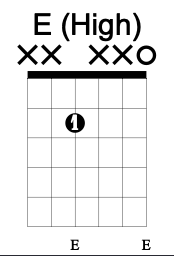
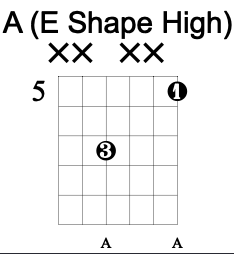
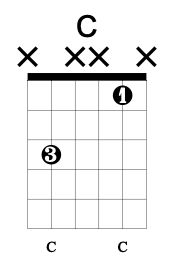
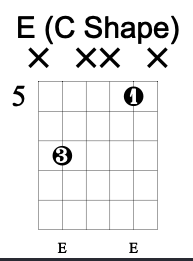
The E chord shape actually has two distinct octave shapes within it: the low one is the box-shape commonly associated with the aforementioned power chords, i.e. “two frets up and two strings higher” while the shape of the E chord’s upper octave is a little more shy about presenting itself. It is the larger upside down L shape that is found between the 2nd fret of the 4th string and the open 1st string. If we move it up one fret we see that it outlines the ‘beginner’ 4-string F chord and, moving onward up the neck, has a shape that can be described as “2 frets down and 3 strings up”. That inverted ‘L’ shape can also be found in the C chord where the octave is found between the 3rd fret of the 5th string and the 1st fret of the 2nd string. It’s the identical “2 frets down and 3 strings up” shape of the upper octave in the E shape.
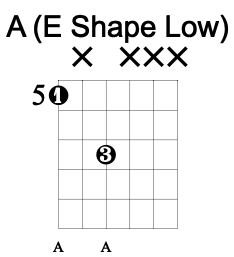
There are 3 E’s and 2 octave shapes in the open E ChordHere we see the upper octave of the E shape; 2 frets down and 3 strings higher.The low octave of the E shape placed at the 5th fretThe High octave of the E shape at the 5th fret
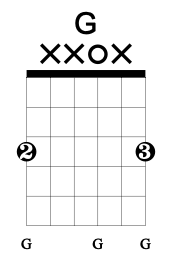
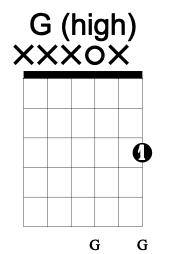
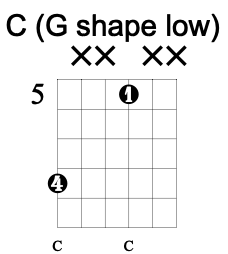
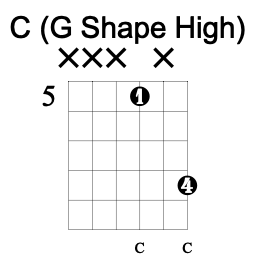
moving to the G shape we have another open chord that contains two octave shapes. This chord’s lower octave is found between the 3rd fret of the 6th string and the open 3rd string. We could say, “3 frets down and 3 strings up”. So, for example, if we looked for the C octave using the lower octave shape of the G chord we would first want to locate the C note at the 8th fret of the low E string and then connect this with the 5th fret of the 3rd string; that follows the 3 frets down and 3 strings up pattern. This shape is a very important one for the octave pedal tone exercise and is a great one to be familiar with because of the amount of space between the octave for melodies and harmonies to be explored!
G chord and it’s 3(!) octave shapes! I would be very remiss to not mention the outer notes and the double octave they make up.Low Octave of the G ShapeHigh octave of the G shapeLow Octave of the G shape at the 8th fret. This is a C Octave in the G shape.High Octave of the G shape at the 5th fret. This is a C octave in the upper register of the G Shape
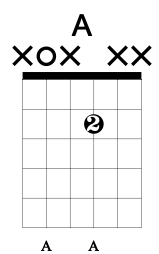
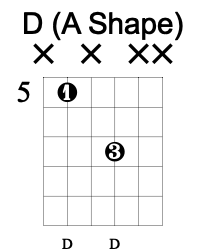
The octave shape found within the A chord shape is identical to the lower octave of the E chord. It is the ‘box’ shape that I earlier described as two frets up and two strings higher.
Open A Octave shapeA Octave Shape at the 5th fret. This is a D octave in the A shape
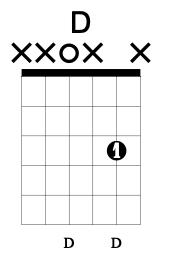
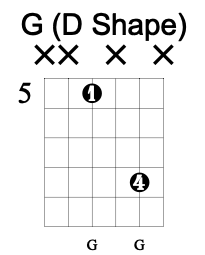
The D chord’s octave shape is found between the open 4th string and the 3rd fret of the 2nd string and as such is identical to the upper octave of the G chord shape.
This is the D Octave shapeThis is the D Octave shape at the 5th fret, which makes this a G Octave
My personal favourite of all the open chord octave shapes is the C chord! It fits beautifully in the hand and offers loads of melodic and harmonic opportunity in between the low and high notes. The M7 is within easy reach with the 4th finger, the b3 to 3 ornament is a simple 1st to 2nd finger hammer on. There are many beautiful colours readily available and with practice you will see them all, no pun intended: )
This is the C Chord’s Octave shape; 2 frets down and 3 strings upThis is the C Chord octave shape at the 7th fret of the A string; making the sound of an E octave
So, looking at the 5 chords of the CAGED system, we find 7 octave shapes: 5 chords plus 2 extras in the G and E shapes. Of those 7 shapes only 4 of them are unique/non-redundant. E and A share a shape; C and E share a shape; D and G share a shape and the one shape that doesn’t share itself with other chords is the lower octave shape of the G chord.
Here is a pdf of all the above shapes in one handy place.
Though I may be belabouring the point a little, the important thing to know is that getting really comfortable with your octave shapes is a great way to bolster your conception and understanding of the harmonic and melodic layout of your fingerboard.
As we build our awareness of the fingerboard on our way to becoming fluent and fluid with the Pattern Generation approach to creative practicing, we must develop our mastery over the major scale. This journey means that we are going to be playing the Octave Pedal Tone exercises from and to notes in the scale other than the Tonic. These can be thought of by their Modal signifiers or they can just be thought of as the Major scale from the 2nd scale degree to the 2nd scale degree an octave higher or lower.
Or the 3rd or the 4th or the 5th etc, etc.
The reason that I’m using the Modal label for these is that (because of the fact that we are pedalling back to the root every other note) we are actually really hearing the mode and it’s colours and tensions, consonance and dissonance in a meaningful way. Every time we hit the root and then go to the next scale degree we are hearing the colour of those notes relative to that pedal tone. There are actually a few different layers of thought that we can be exploring when navigating through the modes in this way.
One layer of thought or perception that we might explore as we move through the exercise is that we have started on the 2nd scale degree and so the W/H pattern will orient itself around that starting point. That is to clumsily say that the 3 of the major scale will be the second note and the 4 will be the third etc. You might narrate the exercise in just that way, i.e. “2 goes a whole step to 3 goes a half step to 4 goes a whole step to 5 goes a whole step to 6 goes a whole step to 7 goes a half step to 8 goes a whole step to 2/9”. There’s a fluidity to that passage that can fit nicely within the 8th note rhythm of a basic pedal tone exercise; you should try it: )
Another perspective you can have is that you are playing a Dorian mode, which is a minor scale with a Major 6th; a Major scale with a flattened 3rd and 7th; or a minor scale that has the scale template: W-H-W-W-W-H-W.
You could also just stay within the musical alphabet and remember that E & F and B & C are always a half step apart while every other adjacent pair is always a whole step.
Whatever perspective you take, what we’re really trying to do here is develop a sense of control, awareness, and fluidity over the scale so that we can reduce limitations and elevate our ability to create and move through the infinite variety of patterns available to us as we write or improvise or work on new melodic/harmonic vocabulary.
This video is played at 80 bpm but you can and should feel open to slowing it down or speeding it up. You can and should add rhythm. You can use a pedal like the EHX Freeze to lay down a chord and hear the harmonic context of all this goodness.
Speaking of playing a pad or chord in the background while playing this exercise, that is exactly the reason why I am not a huge fan of the fact that I have called this exercise a Dorian exercise. It is absolutely the case that if we play this pattern by itself or while sounding a Dmin chord we will hear the character and qualities of the Dorian mode. However, if you play this over a G7 chord/groove you will hear the sound of Mixolydian. If you play it over FMaj7 you will hear it as a Lydian sound. Why is that? Because it’s the chord that defines the modal character/perspective, not the scale!
Mostly.
If you are playing over a drone, let’s say D, and you use the notes of the C Major scale, you will hear the characteristics of Dorian but, if you then shift your note choices to the key of A, you will have manifested the D Lydian mode. Modal music does allow for these creative impositions of modal shifting, but for the vast majority of Classical, pop, blues, jazz, traditional music etc what we are generally experiencing is music that is based around harmonic and melodic interactions, i.e. chord progressions and melodies. If a song has chords that change every couple of beats or bars, it is then, by definition, not Modal music. This is why I struggle to direct a student’s focus towards modal delineations. For certain taxonomically valid reasons however, modal labels have to be acknowledged as useful: )
The real beginning point for any and all of what’s to come is to develop your ability to play up and down the length of every string in any and every key. Without thinking too hard about it! It should not be a challenge to play the G Major scale up and down the B string, or the Ab Major scale up and down the G string.
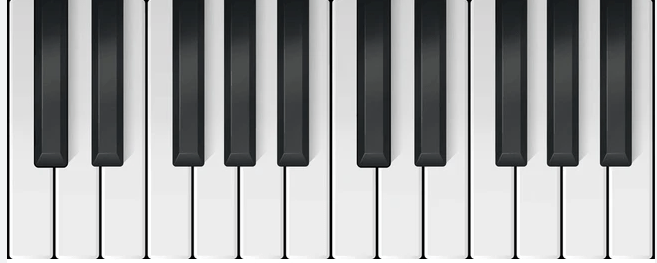
The formula is twofold: the first most important thing to remember is the Major Scale Template, which is that the spacing between the notes from tonic to tonic is W W H W W W H (where W represents a Whole step and H represents the Half step.) In order to internalize this easily just think of the piano keyboard…if you can’t think of it use this device your looking at this artical on and find a photo: ) What you will notice if you look even remotely closely is that there is a pattern/sequence of black keys that alternate in groups of 2 and 3. Just like our W/H pattern in the Major Scale Template. THe group of two black keys represents the group of two Whole Steps and the group of three black keys represents the group of three Whole Steps. The gaps in between the black keys where we find two white keys side by side are the naturally occurring Half Steps in the Major Scale. the two white keys following the group of 2 black keys are the half step between E and F, or 3 and 4, while the two white keys following the group of 3 black keys is the Half Step between B and C, or 7 and 8. Take a minute, there’s not rush and there’s no pressure. Just remember W-W-H-W-W-W-H; Two black keys and a space then Three black keys and a space.
From this we derive the second part of the formula: the Half Steps are found in between the 3rd & 4th and 7th & 8th notes of the scale. This is important because if you know where your starting note is located in the diatonic scale number system, you can guide yourself along the string by counting steps and moving in Whole steps unless you are moving up or down between the 3rd & 4th or 7th & 8th degrees (notes). It’s not that tricky once you get your hands into it!
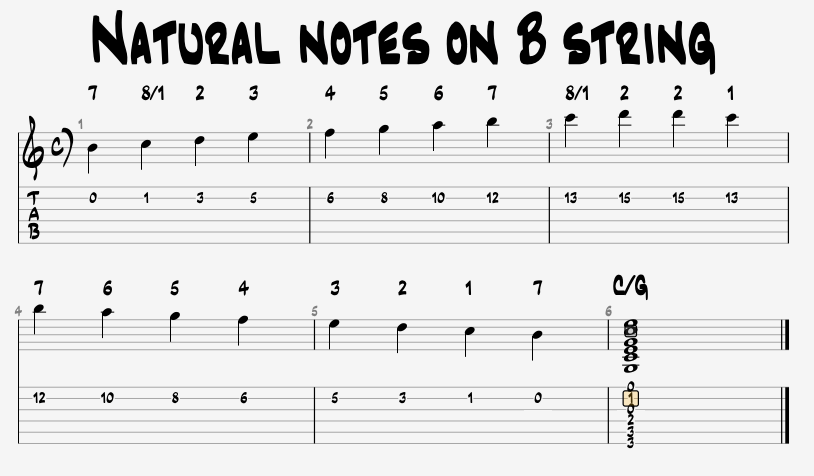
Check out the following images:
The only times in the above example where we move in a one fret increment are between the 3rd and 4th or the 7th and 8th notes of the scale. We start on E because it’s the lowest note on the string. E is the 3rd note in the C Major scale (C-D-E) and so the next note is the 4th and we see that it is up only one fret, or one Half Step. Following steps 4, 5, and 6, which are unsurprisingly all Whole Steps, we get to the next Half Step which is between B and C or notes 7 and 8 in the scale. Then we move through scale degrees 1, 2 and 3, whereupon we arrive again at a half step between scale degrees 3 and 4 only this time one octave higher than the first two notes on the string and we decide somewhat arbitrarily to top out at the 15th fret with a High G. THen we descend along the string playing all the same notes only in reverse. That’s basically how this will work for all 6 strings.
Summarily, B is the open string and that is the 7th of the C Major scale so the very next note is 8/1 and that is why we moved by one Half Step. We see the next Half Step at the 5th and 6th frets, between the notes E and F which also happen to be the 3rd and 4th notes in C respectively. We proceed up the string to the High D and then back down. We will be ending each example with a big C/G chaser just to give harmonic context and resolution to the preceding scale passage.
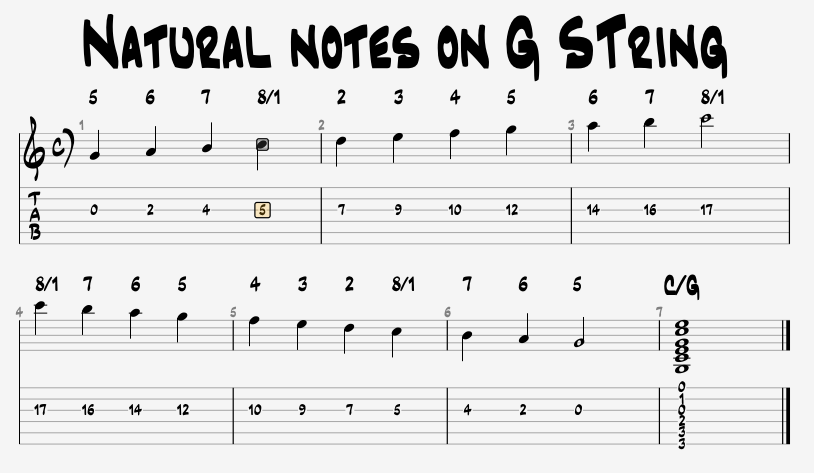
This is the first time that the first two notes on the string are two frets apart, or one Whole Step. Why is that? Because the first note is G, or the 5th of the C Major scale and the distance between the 5th and 6th scale degrees is a Whole Step or 2 frets. Proceed slowly and musically and track your notes always. The tab is presented here merely as a reference. These maps need to be generated in your hands and eyes and brain. Trust me that your ear WILL lead you astray! That’s because none of these examples starts on the tonic. That means you will not get the ‘Do Re Mi’ that your ear is so desperately searching and hoping for! Engage the narrative! Use the numbers! Play half steps only between the 3rd and 4th notes and the 7th and 8th notes of the scale. Always be aware of where you started and where you are going.
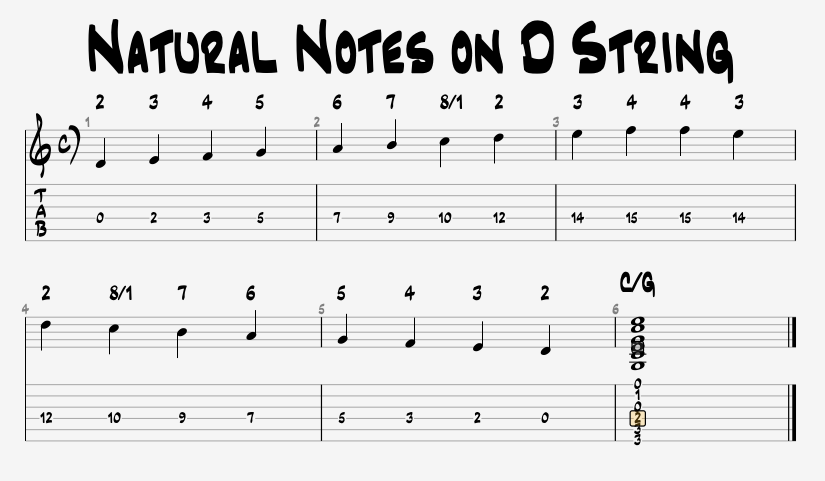
I’m saying a lot, I’m going to let you see/play/think your way through this one.
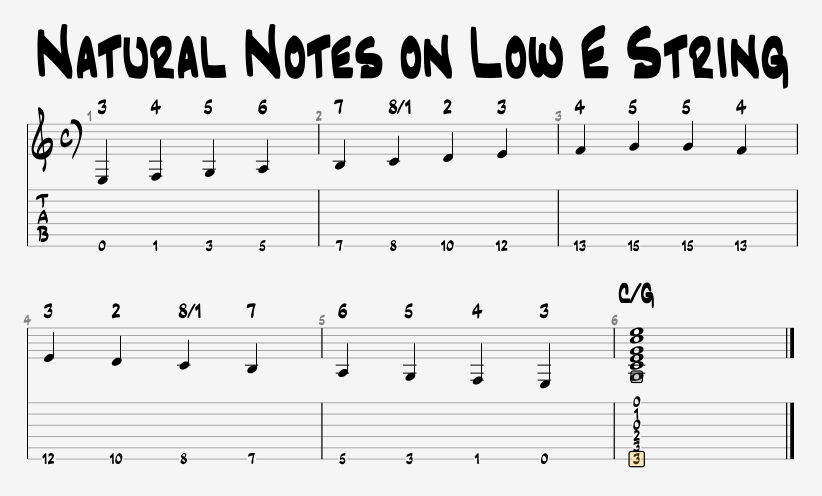
And this one…
The Low E String is identical to the High E String except that it is two octaves lower in pitch. I always like to use these two strings to feel, in a musical way, the old passage “As above, so below”. An interesting bit of physics is that the reason for this two octave difference between the two Es is that the low E string is vibrating at exactly 1/4 the rate of the High E String, exactly! The E that is one octave lower than the High E string is vibrating at exactly 1/2 the frequency rate of that Hi E note, which as we might notice is available to us in a number of places along the neck. Can you find them all?
IMHO this doesn’t so much need a video but I will work on one nonetheless, so check back for a link to that in a day or two. Until then, as usual, happy practicing!
Aside from the technical/theoretical aspects of the Pattern Generation approach to practicing, the most important thing about it is the fact that YOU get to impose YOUR stylistic bent on the exercises in as creative and technically challenging a way as you choose.
Take for example this elaboration on the basic C Major scale tonic-to-tonic rendering of the octave pedal-tone exercise:
In this video I decided to apply a rhythm to the octave pedal tone exercise that harkens back to 80s hair metal, a la Dokken or Ratt with its muted low notes and squelchy higher notes. I don’t know why I chose this as it’s not at all what I do musically but I’m a child of the 80s so I guess this kind of thing is never far from my hands no matter how hard I try: )
The pattern that I applied is a two-parter in which the first pair of notes is played as low-low-high-low (LLHL) and the second pair is played as low-high-low-low (LHLL) in order to offset the rhythm in a somewhat stylistically typical way. In this example, and because of the tempo, I’m playing with an all downstrokes approach but if the tempo was higher I might switch to alternate picking. If you’re trying to get your metal downstroke speed up into Hetfield territory then you might want to practice this exercise until you can do it at bpm=160 or faster, it’s totally up to you.
This is the first of a radically high number of possible octave pedal-tone exercises. In this one, we start at the open position C Major scale fingering and sort of inchworm our way all the way up to the high C on the 20th fret of the high-E string and then work our way back down so that we descend into a Unison through the same register we started in. The difference in the last octave sequence as compared to the first octave sequence is that we are now descending to the unison in the 5th position. Some CAGED-style thinkers might C this as the G shape, as opposed to the opening patterns movement through the C shape.
One possible goal is to create as much overlap and ringing connection between notes as possible. Another equally fine approach is to make the notes as detached as possible. The choice really is up to you and the style you are working within, or towards, or maybe even away from?
To achieve a strong foundation for future pattern generation development it is very important to keep track of where your moving voice is in the scale. To this end, even more than being aware of the letter names you are playing–though that is pretty crucial at the outset–you will want to practice seeing the notes you are playing relative to their scale degrees. So, for the C Major scale, C = 1; D = 2; E = 3; F = 4; G = 5; A = 6; and B = 7 and C at the octave, above or below = 8. This first exploration expands and contracts only between single octaves and a unisons so there is no need to consider compound intervals though at some point 2=9, 3-10, 4=11, and 6=13 will become valuable.
Here is the play through for reference. Feel free to play it slower or faster, or with distortion or not. All of these decisions are yours to make. Happy pattern generating.





 Pattern Generation